QLED vs OLED: A Practical Buyer's Guide
Recommended picks


How QLED Works
QLED stands for Quantum Light-Emitting Diode. Behind the LCD layer sits a sheet of quantum dots, tiny semiconductor particles that convert blue LED backlight into purer red and green light before it passes through the panel. The result is wider color coverage and higher peak brightness than a standard LED TV. Because the backlight is always on to some degree, very dark scenes can look slightly washed out compared to OLED, though premium sets use local dimming zones to reduce this. The Samsung QN65Q80DAFXZA (65", 4K, 120 Hz, rated 4.2 stars across 418 reviews, priced around $917) is a representative mid-range QLED that pairs a bright panel with Samsung's Tizen smart platform.
How OLED Works
OLED stands for Organic Light-Emitting Diode. Every pixel in an OLED panel generates its own light and can switch off completely. That produces true blacks, extremely thin bezels and cabinets, and very wide viewing angles where color stays accurate even from the side. The trade-off is lower peak brightness compared to the brightest QLEDs, which makes OLED less ideal in sunlit rooms. OLED panels also carry a risk of permanent image retention (burn-in) if the same static graphic sits on screen for hundreds of hours, though modern panels include mitigation features that make this a minor concern for typical viewing habits.
Brightness and Glare Resistance
Peak brightness is where QLED wins clearly. Flagship QLED sets can reach 1,500 to 2,000 nits or more in HDR highlight windows, while most OLED sets top out at 800 to 1,000 nits on the brightest models. In a room with windows or overhead lights, that extra brightness keeps highlights punchy and prevents the screen from looking washed out. The Hisense 75U6HF (75", 4K, 60 Hz QLED, $997, 4.2 stars across 4,800 reviews) is a popular pick for large, bright living rooms because it delivers solid QLED brightness at a price well below premium Samsung options. For a dim home theater where ambient light is controlled, OLED's contrast advantage typically outweighs the brightness gap.
Contrast and Black Levels
OLED panels produce the deepest blacks available in a consumer TV because an unlit pixel emits no light at all. Measured contrast ratios for OLED often exceed 1,000,000:1, a figure that is essentially unmeasurable in practice. QLED sets rely on local dimming, where the backlight dims in blocks or zones behind dark areas of the image. High-end QLED sets with many dimming zones come close, but a small halo or bloom of light can appear around bright objects on a dark background. If you plan to watch a lot of movies or cinematic content in a dark room, OLED's black level advantage is visible and meaningful.
Price and Size Options
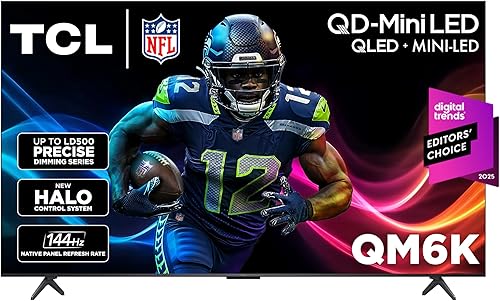
QLED is available at almost every price point and in sizes ranging from around 32 to 98 inches. The TCL 55QM6K (55", 4K, 144 Hz QLED, $447.99, rated 4.4 stars across 1,689 reviews) shows how far QLED value has come: a 55-inch set with a 144 Hz panel for under $450. OLED sets start higher, typically $700 and up for a 48-inch entry-level panel, and premium 77-inch OLED models often cost twice what a comparable QLED costs. If budget is the deciding factor or you need a very large screen, QLED gives you more options.
Gaming Performance
Both technologies can be excellent for gaming, but the details matter. Look for a set with a 120 Hz or 144 Hz refresh rate, HDMI 2.1 ports (for 4K at 120 fps), low input lag, and support for VRR (variable refresh rate) formats like AMD FreeSync or Nvidia G-Sync Compatible. OLED's per-pixel response is extremely fast, which helps with motion clarity. Many QLED sets now match or approach that speed at 144 Hz, particularly TCL and Hisense mid-range models. Either type works well for gaming if the specs are present; the panel technology is less important than the refresh rate and port configuration for most players.
Common mistakes to avoid
- Judging QLED vs OLED in a brightly lit store where QLED always looks better because of its higher brightness, rather than considering the actual light levels in your room.
- Assuming all QLED sets have the same picture quality. Entry-level QLED panels with few or no local dimming zones look much closer to a basic LED TV than a high-end QLED with full-array local dimming.
- Worrying too much about OLED burn-in for typical mixed-use viewing. Permanent retention requires showing the same static image for hundreds of hours, which is unlikely in normal TV and streaming use.
- Overlooking refresh rate when buying. A 60 Hz QLED and a 60 Hz OLED will both show motion blur in fast-paced sports or games; a 120 Hz or 144 Hz panel fixes that regardless of which panel type you choose.
- Comparing peak brightness numbers without checking screen size. A 98-inch QLED needs more raw brightness to achieve the same nit level per square foot as a 55-inch panel.
- Buying on panel type alone rather than checking the return policy. Picture preference is personal; a risk-free return window lets you confirm the TV works in your space before you commit.
Frequently asked questions
Is OLED better than QLED for everyday TV watching?
It depends on your room. OLED produces deeper blacks and more accurate colors in a dark or dim room, which makes movies and dramas look exceptional. In a bright living room with windows and overhead lights, a QLED's higher peak brightness holds up better and the picture looks less washed out. For most living rooms with mixed lighting, a well-priced QLED is the practical choice. If you watch mostly at night in a controlled environment, OLED is worth the premium.
Will an OLED TV get burn-in from normal use?
Burn-in from ordinary mixed-use viewing is unlikely. The risk is real only when a bright static image, such as a news ticker, a sports score overlay, or a game HUD, displays in the exact same screen position for many hundreds of hours. Modern OLED TVs include pixel-shift and screen-saver features that reduce the risk further. If you leave the TV on a single channel with static graphics all day every day, you should take burn-in seriously. For normal streaming, movies, and varied channel surfing, it is not a practical concern for most owners.
Can I get a large QLED TV for less than a large OLED?
Yes, significantly less. A 75-inch QLED such as the Hisense 75U6HF costs around $997, while a 77-inch OLED from any major brand typically runs $1,500 to $2,500 or more. The price gap widens as screen size increases. If screen size matters more to you than the deepest possible blacks, QLED lets you buy more inches for the same money.
Does QLED or OLED look better for sports?
For sports, fast motion handling and brightness matter most. A 120 Hz or 144 Hz QLED with good motion processing handles sports very well, and the higher brightness keeps a daytime game looking vivid even in a sunny room. OLED also handles motion well at 120 Hz, and some owners prefer its color accuracy for skin tones. The practical difference for sports comes down to room brightness more than panel type: pick QLED for bright rooms and OLED for dark dedicated viewing spaces.
Who should I contact if I have questions about a specific TV on RalTV?
You can reach the RalTV team at hello@raltv.com. Include the TV model you are asking about and a brief description of your question and we will get back to you as soon as possible.