How Far Can a TV Antenna Reach?
Recommended picks


What the Range Number on the Box Actually Means
Manufacturers test antenna range in open, flat terrain with no interference, which is rarely the environment in your living room or attic. A rating of '65 miles' means the antenna captured a usable signal at that distance during controlled testing. In real installations, physical obstacles such as hills, tree lines, tall buildings, and even rain reduce that figure considerably. Think of the advertised range as a ceiling you can approach but probably will not hit unless you are on flat ground with a clear line of sight to the towers. Treat the rating as a useful comparison tool between models rather than a precise promise.
Indoor Antennas: Realistic Range
A flat indoor antenna placed near a window or on top of a TV typically works well within 25 to 40 miles of towers. The GE 29884-PK1, rated 4.4 stars across more than 10,600 reviews and priced around $38.98, is a popular choice in this category, with buyers in suburbs reporting solid reception on major networks. Walls, floors above you, and appliances all attenuate the signal, which is why the same antenna can perform very differently from room to room in the same house. If your towers are 40 to 55 miles out, an amplified indoor antenna may bridge the gap, but results vary with your specific building materials and layout.
Outdoor and Attic Antennas: Where Range Improves Significantly
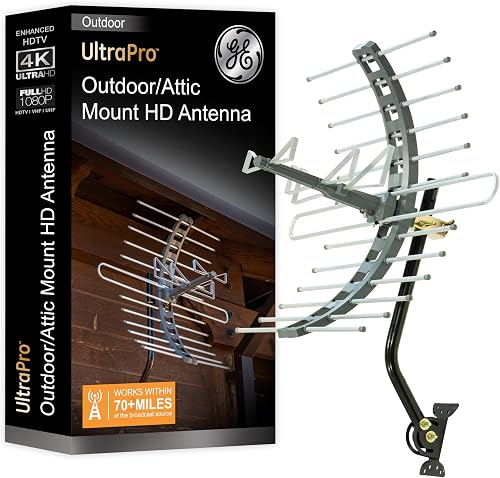
Moving an antenna outside or into the attic eliminates the biggest source of signal loss, which is the building structure itself. An outdoor antenna like the RCA ANT751E, priced around $63.94 and rated 4.4 stars by more than 12,400 buyers, is designed for medium-range reception in the 45 to 70 mile window. Height matters as much as hardware: every 10 feet you gain in mounting elevation extends your practical range because the antenna clears more of the obstructions between you and the tower. Even placing a compact antenna in an open attic, rather than behind a wall, often yields noticeably better results than the best indoor flat antenna on a windowsill.
Long-Range Outdoor Antennas: Pushing Past 70 Miles
Directional outdoor antennas built for fringe reception, like the Winegard HD7694P at $149.99 with a 4.4-star rating across 1,200 reviews, are engineered for situations where towers are 70 to 100 miles away. These antennas have larger element spans and higher gain ratings, which help them focus on a narrow slice of the sky and reject noise from other directions. The tradeoff is that a highly directional antenna requires careful aiming, and if your towers are scattered in different directions, you may need a rotor or a second antenna. For most people beyond 60 miles, the combination of a quality long-range outdoor antenna, a quality coax cable, and a high mounting point delivers the biggest gains.
Factors That Cut Range in Practice
Terrain is the single biggest variable: a 50-mile antenna on flat land in Iowa will outperform a 100-mile antenna in a hilly region of western Pennsylvania. Dense tree cover blocks UHF signals more than most buyers expect, and leafy summer foliage can degrade a signal that was rock-solid in winter. Coax cable quality matters too: a long run of cheap RG59 cable introduces enough loss to make a marginal signal unwatchable, while RG6 cable keeps losses low over longer runs. Electrical interference from LED bulbs, routers, and power lines can create noise that drowns out weak stations even when distance is not the problem. Addressing these factors often does more for reception than switching to a more expensive antenna.
How to Find Your Actual Distance to Towers
The FCC's DTV Reception Maps and third-party tools like AntennaWeb let you enter your address and see which towers are within range, what direction they are in, and how strong the signal is expected to be at your location. Stations are color-coded by signal strength, which helps you identify whether you need a simple indoor antenna or a long-range outdoor model. If most of your local stations are within 35 miles and in roughly the same direction, an amplified indoor or compact outdoor antenna is probably all you need. If stations are split between two directions 40 or more miles out, plan for a directional antenna with a rotor, or a multi-directional outdoor model with a signal amplifier.
Common mistakes to avoid
- Buying the antenna with the highest mileage rating instead of matching the rating to actual tower distance.
- Placing an indoor antenna flat on a shelf behind a TV instead of near a window or exterior wall where the signal is stronger.
- Using long runs of old RG59 coaxial cable instead of RG6, which adds enough signal loss to kill a marginal channel.
- Adding a signal amplifier when interference, not weak signal, is the real problem. Amplifiers boost noise along with the signal and can make things worse.
- Not checking tower directions before buying a highly directional antenna, then finding that your stations are spread across too wide an arc to aim at one spot.
- Skipping the free tower-lookup step and guessing range based on zip code alone, which can lead to buying an indoor antenna for a location that actually needs an outdoor model.
Frequently asked questions
Does a more expensive antenna always mean more range?
Not automatically. Price generally reflects build quality, element size, and the presence of a built-in amplifier, all of which contribute to range, but a well-placed $40 outdoor antenna will usually outperform a $120 indoor antenna simply because of its location. Spend your money on the right category first, then consider stepping up within that category if needed.
Will an amplifier help me pick up stations that are farther away?
An amplifier helps when the signal reaching your antenna is genuinely weak due to distance, but it is not a solution to a poor antenna position or excessive cable length from poor-quality coax. If the antenna is positioned well but the signal is marginal because of distance, a low-noise amplifier at the antenna end of the cable can make a real difference. If the core problem is interference or a blocked line of sight, amplification will not fix it.
Can I use one antenna to receive channels from towers in opposite directions?
A multi-directional or omnidirectional antenna handles this better than a tight-beam directional model. If your towers are spread more than 90 degrees apart, a directional antenna on a motorized rotor is another option, though it cannot point two ways at once. For most suburban situations with towers within 40 miles, a multi-directional outdoor antenna picks up signals from multiple directions without any adjustment.
Why do some channels drop out even though they are within range?
Over-the-air digital signals behave differently from old analog broadcasts: the picture is either clear or gone, with little in between. A station at the edge of your antenna's range may come in perfectly most days and disappear during rain, high humidity, or when leaves fill out in summer because those conditions scatter UHF signals. Raising the antenna higher and using quality RG6 coax from the antenna down to the TV reduces the likelihood of dropouts near the edge of your reception zone.
Is there a difference in range between VHF and UHF channels?
Yes. VHF channels, which cover the old channels 2 through 13, travel farther and bend more readily around terrain than UHF signals, which cover channels 14 and above. Most modern flat indoor antennas are optimized for UHF, so if your local NBC or PBS affiliate still broadcasts on a low-VHF channel, you may need an antenna with longer elements or a dedicated VHF element to receive it reliably. Tower-lookup tools show you which band each station uses, so check that before you buy.