What Channels Can I Get With an Antenna?
Recommended picks


The Major Networks You Can Expect
Antennas receive over-the-air signals broadcast in the VHF (channels 2 to 13) and UHF (channels 14 to 36) bands. In most metro areas, that means clear access to ABC, CBS, NBC, Fox, PBS, The CW, and MyNetworkTV. PBS alone often carries four or five subchannels with distinct programming, so a single main channel can expand into a full block of content. ION Television, Telemundo, and Univision are also widely available over the air in markets with large Spanish-speaking populations. What you receive depends entirely on which stations your local towers are broadcasting, not on any package or plan.
Subchannels Add a Lot More Than You Might Expect
Every broadcast license can carry multiple streams, called subchannels, alongside the main feed. Common subchannel networks include MeTV (classic TV), Comet (sci-fi), Grit (westerns and action), Laff (comedies), GetTV, and Bounce TV. Local stations also run news and weather subchannels that update around the clock. A market with 10 licensed broadcasters might offer 30 to 50 total subchannels once you count everything. Running a full channel scan on your TV is the only reliable way to find out exactly what is available at your address.
How Distance and Terrain Affect Your Count
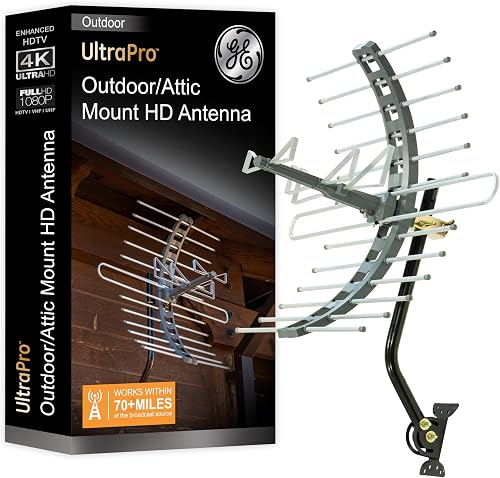
Broadcast signals travel in straight lines, so hills, tall buildings, and thick forests between your home and the tower reduce signal strength. Most indoor antennas perform reliably within 25 to 35 miles of a tower cluster. A compact indoor model like the GE 33681, rated 4.2 stars across 1,777 reviews and bought by roughly 4,000 households a month, works well in that range for urban and suburban viewers. At 40 to 70 miles, an amplified outdoor antenna becomes more practical. The RCA ANT751E, rated 4.4 stars across more than 12,400 reviews at $63.94, is a compact outdoor option designed for moderate distances. Beyond 70 miles, a large directional outdoor antenna pointed precisely at the nearest tower cluster gives the best results.
Indoor vs. Outdoor Antennas and Channel Count
Indoor antennas are simple to set up and cost as little as $10 to $40, making them a starting point for apartment dwellers and renters. They work best near a window facing the broadcast towers and can easily pull 25 to 40 channels in a suburban market. Outdoor and attic-mounted antennas reject more interference and cover longer distances, which directly translates to more channels and a more stable signal. The GE 29884-PK1 is an outdoor-ready model rated 4.4 stars by more than 10,600 reviewers, priced at $38.98, and bought by about 4,000 people a month. If your market has towers in two different directions, a rotating outdoor antenna lets you aim at each cluster without physically repositioning.
How to Find Out Exactly What Is Available at Your Address
The FCC maintains a free tool at tv.fcc.gov/fcc-bin/tvq.exe where you can enter a zip code and see every licensed station in range along with signal strength estimates. AntennaWeb.org and RabbitEars.info offer similar lookups and will tell you which antenna type each tower requires. These tools show the physical channel number, the network affiliation, and whether the signal is VHF or UHF, which helps you choose an antenna that handles both bands. Check a few nearby zip codes too, because towers do not always align neatly with city limits. For questions specific to your setup, contact us at hello@raltv.com.
Getting More Channels From What You Already Have
Antenna placement matters more than most people realize. Moving an indoor antenna two feet higher or closer to a window can mean the difference between 20 and 40 channels. Avoid placing it behind a TV, near a microwave, or inside a metal entertainment center. If signal strength is borderline, a signal amplifier can help, but only if the underlying signal is present. Amplifying a signal that is already too weak does not recover missing channels and can introduce noise. Splitting the antenna signal to multiple TVs weakens the signal at each set, so use only as many splitter outputs as you actually need.
Common mistakes to avoid
- Scanning channels only once and not rescanning after repositioning the antenna, which locks in a weaker result.
- Placing an indoor antenna directly behind or beside the TV, where the TV's own electronics create interference.
- Buying an amplified antenna expecting it to reach channels that are physically out of range for any antenna.
- Using a four-way splitter when only two TVs are connected, cutting signal strength unnecessarily.
- Assuming the antenna range number on the box is guaranteed, when it reflects best-case open-field conditions.
- Ignoring VHF coverage: some antennas only receive UHF well, and several major network affiliates still broadcast on VHF channels.
Frequently asked questions
Will I get the same channels my neighbors get?
Not necessarily. Building materials, roof pitch, nearby trees, and even the specific model of antenna all affect reception. Two houses on the same block can get meaningfully different channel counts. Running a channel scan from your actual location is the only reliable test, since online tools give estimates based on terrain models that do not account for every obstacle.
Can I get local news and sports with an antenna?
Yes. Local news on ABC, CBS, NBC, and Fox affiliates broadcasts over the air, which means it comes in free with an antenna. Live NFL games on those same networks are also free over the air. Cable-only sports like ESPN or regional sports networks are not available via antenna, but national broadcasts on broadcast networks are included.
Do I need an internet connection for an antenna to work?
No. Over-the-air TV is completely independent of your internet service. The signal travels from broadcast towers to your antenna entirely over radio waves, and your TV's built-in tuner decodes it directly. No account, app, or login is involved.
Why does my channel count drop or change on some days?
Atmospheric conditions, weather fronts, and seasonal changes in humidity can cause distant signals to strengthen or weaken temporarily, a phenomenon called tropospheric ducting. Very hot or humid days may bring in channels from 100-plus miles away, while storms can reduce a normally stable signal. This is normal behavior and not a sign that your antenna or TV is defective.
Can one antenna feed multiple TVs in my house?
Yes, using a coaxial splitter. Each split reduces signal strength, so a two-way split loses roughly 3.5 dB per output and a four-way split loses around 7 dB. In strong-signal areas this is not a problem. If some TVs lose channels after splitting, a distribution amplifier placed before the splitter can compensate, provided the original signal is strong enough to amplify cleanly.