Indoor vs Outdoor TV Antenna: Which One Actually Works for You?
Recommended picks


How Indoor Antennas Work and Where They Fit
Indoor antennas sit on a windowsill, behind a TV, or flat against a wall. They are small, cheap, and take about five minutes to set up. The GE 33681, priced at $19.72 and rated 4.2 stars across 1,777 reviews, is one of the most consistently purchased indoor antennas around, with roughly 4,000 units bought last month alone. The tradeoff is simple: the closer you are to broadcast towers and the fewer walls or buildings in the signal path, the better an indoor antenna performs. Concrete walls, metal roofing, and large appliances all degrade reception inside the home, which is why placement near a window facing the towers matters.
How Outdoor Antennas Work and Where They Fit
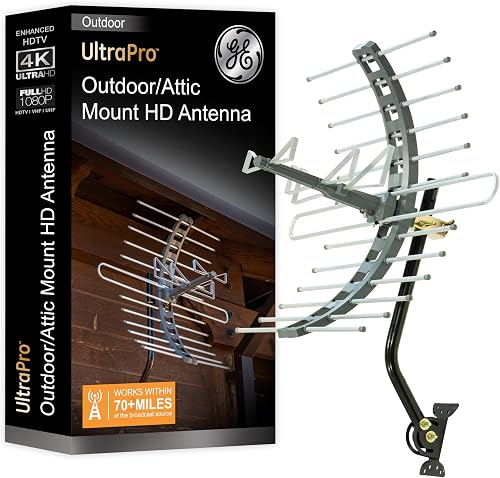
Outdoor antennas are mounted on a roof, exterior wall, or inside an attic. Because they sit above most obstacles, they pick up weaker signals that an indoor model would miss entirely. The RCA ANT751E at $63.94 has over 12,400 reviews and a 4.4-star rating, making it one of the best-documented outdoor directional antennas available. Outdoor setups require a coaxial cable run from the antenna to your TV, grounding for lightning protection, and in most cases a mounting pole or mast bracket. The Winegard HD7694P at $149.99 weighs 6.7 lb and is rated 4.4 stars across 1,200 reviews, reflecting its position as a step up for viewers dealing with longer distances or more interference. Attic installation splits the difference: you avoid the weather exposure of a roof mount but still gain the height advantage over an indoor placement.
The Distance and Terrain Decision
Distance to towers is the clearest dividing line. Under 25 miles with flat terrain, virtually any indoor antenna works. From 25 to 50 miles, you are in the gray zone where an amplified indoor antenna may work, or may not, depending on your specific location and building materials. Beyond 50 miles, outdoor is almost always the only realistic option. Hilly or wooded terrain subtracts effective range on top of raw distance. A viewer 30 miles out in a valley with surrounding hills can face worse reception than someone 45 miles out on a flat plain.
Signal Direction: Omnidirectional vs Directional
If all your local towers cluster in one direction from your home, a directional antenna pointed straight at them delivers the strongest signal. If your towers are spread across different compass points, an omnidirectional design picks up signals from all sides without rotating the antenna. Many outdoor antennas are directional by design, which means you may need a rotator if you want channels from multiple directions. Indoor antennas are generally omnidirectional because signal levels are too low to rely on a precise aim. Checking the actual tower bearings from your address before buying saves a return trip.
Amplified vs Passive: What the Amp Actually Does
An amplifier boosts the signal after the antenna receives it, which helps overcome long coaxial cable runs and splitters. It does not extend your antenna range in any meaningful way, and if you are already in a strong-signal area, an amp can introduce noise that actually makes reception worse. The GE 29884-PK1 at $38.98 is one of the most popular amplified indoor antennas with 10,600 reviews and a 4.4-star rating, selling roughly 4,000 units per month. An amp makes the most sense when you are running cable more than about 25 feet or splitting the signal to multiple TVs. If you are plugged directly into one TV within 15 feet of cable, a passive antenna is often cleaner.
Installation and Practical Considerations
Indoor antennas require no tools beyond a coax cable already attached to your TV tuner. Outdoor antennas add a few hours of work for mounting, cable routing, and grounding, plus any permits your local jurisdiction may require for roof work. Attic installations skip the grounding requirement in most cases and take far less time than a full roof mount. Budget for a quality RG6 coaxial cable if you run more than a short distance, since cheap or damaged cable is a common cause of reception problems that have nothing to do with the antenna itself. If you rent or cannot mount hardware outdoors, a well-placed indoor antenna near an exterior window will often surprise you with how many channels it pulls.
Common mistakes to avoid
- Buying an outdoor antenna based on the claimed mileage range on the box without checking actual tower distance and direction at your address first.
- Placing an indoor antenna in the center of a room or on top of a media console instead of near an exterior window facing the broadcast towers.
- Adding an amplifier in a strong-signal area, which can cause the tuner to overload and drop channels rather than gain them.
- Running a single antenna through a cheap passive splitter to four or five TVs without accounting for the signal loss each split introduces.
- Skipping the grounding step on an outdoor roof-mounted antenna, which creates a lightning strike risk to your home and equipment.
- Giving up after one scan placement. Moving an indoor antenna just a few feet, or rotating it slightly, can dramatically change the channel count.
Frequently asked questions
Can an indoor antenna really replace cable for local channels?
Yes, for most viewers within 30 to 40 miles of a major market. Broadcast networks transmit ABC, NBC, CBS, FOX, PBS, and independent stations over the air in full 1080i HD at no subscription cost. An indoor antenna like the GE 33681 at $19.72 picks up these signals without any monthly fee. The limitation is that you only get local over-the-air channels, not cable-only networks.
Does it matter which direction I point my indoor antenna?
It can, especially for flat or panel-style designs. Rotating the antenna so its face is roughly aimed toward your broadcast towers sometimes adds one or two channels on the edge of reception. For most loop or dipole designs, try both vertical and horizontal orientations and run a channel scan after each. Moving closer to an exterior window almost always matters more than precise aiming.
Is an attic antenna as good as a roof-mounted antenna?
An attic antenna performs noticeably better than an indoor antenna and avoids most weather and grounding concerns. However, roofing materials, especially metal or tile, can reduce signal strength compared to a fully exposed roof mount. For most suburban viewers within 40 to 50 miles of towers, attic installation is a practical middle ground. Beyond 50 miles with obstructions, a roof mount has a clear advantage.
Do I need a special antenna for 4K over-the-air broadcasts?
No. Any antenna that receives ATSC signals works with ATSC 3.0 (NextGen TV) broadcasts, though your TV or tuner also needs to support ATSC 3.0 to decode them. Standard antennas from any brand pick up both ATSC 1.0 (current broadcast standard) and ATSC 3.0 signals without any hardware change. The antenna itself is not the bottleneck for 4K over-the-air reception.
How do I know if I need an amplified outdoor antenna or a passive one?
If your coaxial cable run from antenna to TV is under 30 feet and you are not splitting the signal, a passive outdoor antenna is usually cleaner. Add an amp when you are running 50 feet or more of cable, splitting to multiple TVs, or when signal strength readings in your TV menu show weak but not absent signal. Questions? Reach us at hello@raltv.com.